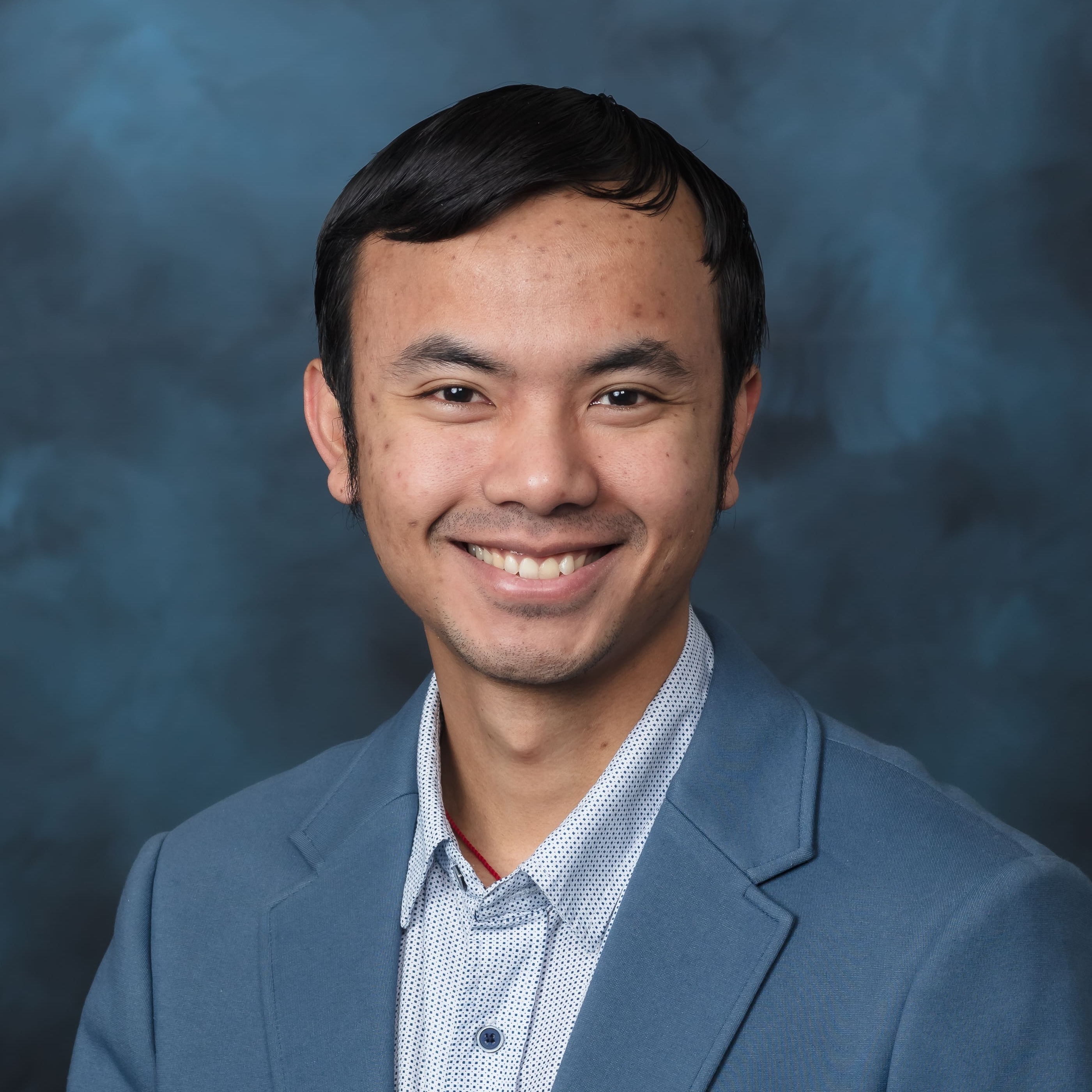
Hi, I'm George Yumnam

Postdoctoral researcher in experimental quantum magnetism

I use neutron and resonant X-ray scattering, supported by modeling, to understand how spin, charge, and lattice degrees of freedom cooperate to form unconventional magnetic states and excitations.

About Me

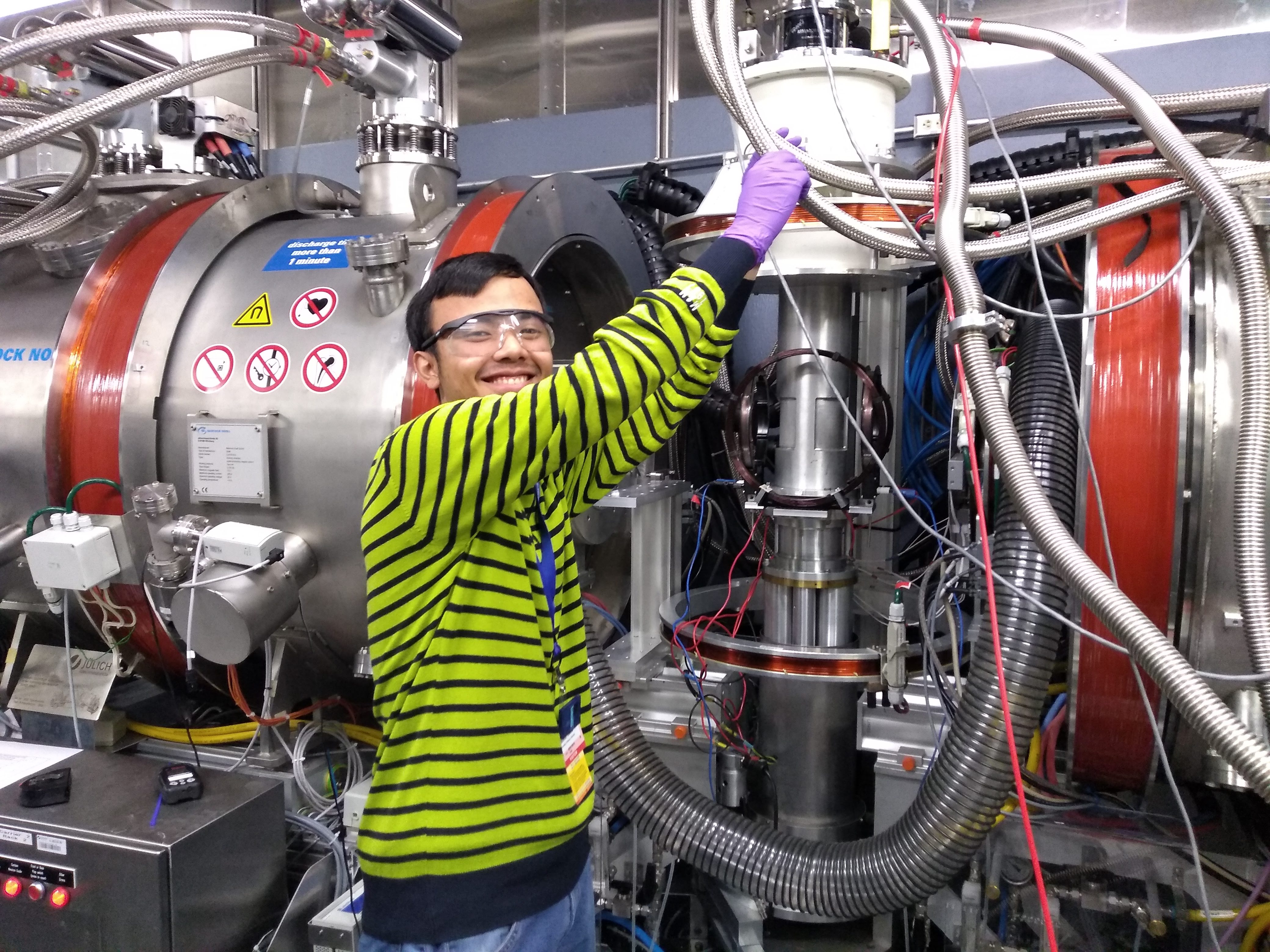
I am an experimental condensed-matter physicist working primarily with neutron and X-ray scattering. My research asks how collective spin dynamics, lattice vibrations, and electronic structure conspire to produce useful magnetic functionalities.

Much of my work focuses on correlated oxides and artificial spin systems — from itinerant antiferromagnets such as RuO2, to lithium-doped MnTe and artificial permalloy honeycomb lattices. I combine elastic and inelastic neutron and X-ray scattering with data-driven modeling to build quantitative, falsifiable models of their magnetic ground states and excitations.

Research Areas

Magnetism & Spintronics
Neutron Scattering
X-ray Scattering
Lattice Dynamics
Condensed Matter
Quantum Materials
DFT Simulation
Data Analysis

Research Initiatives

Magnon-Phonon Interactions

Magnon-Phonon Interactions

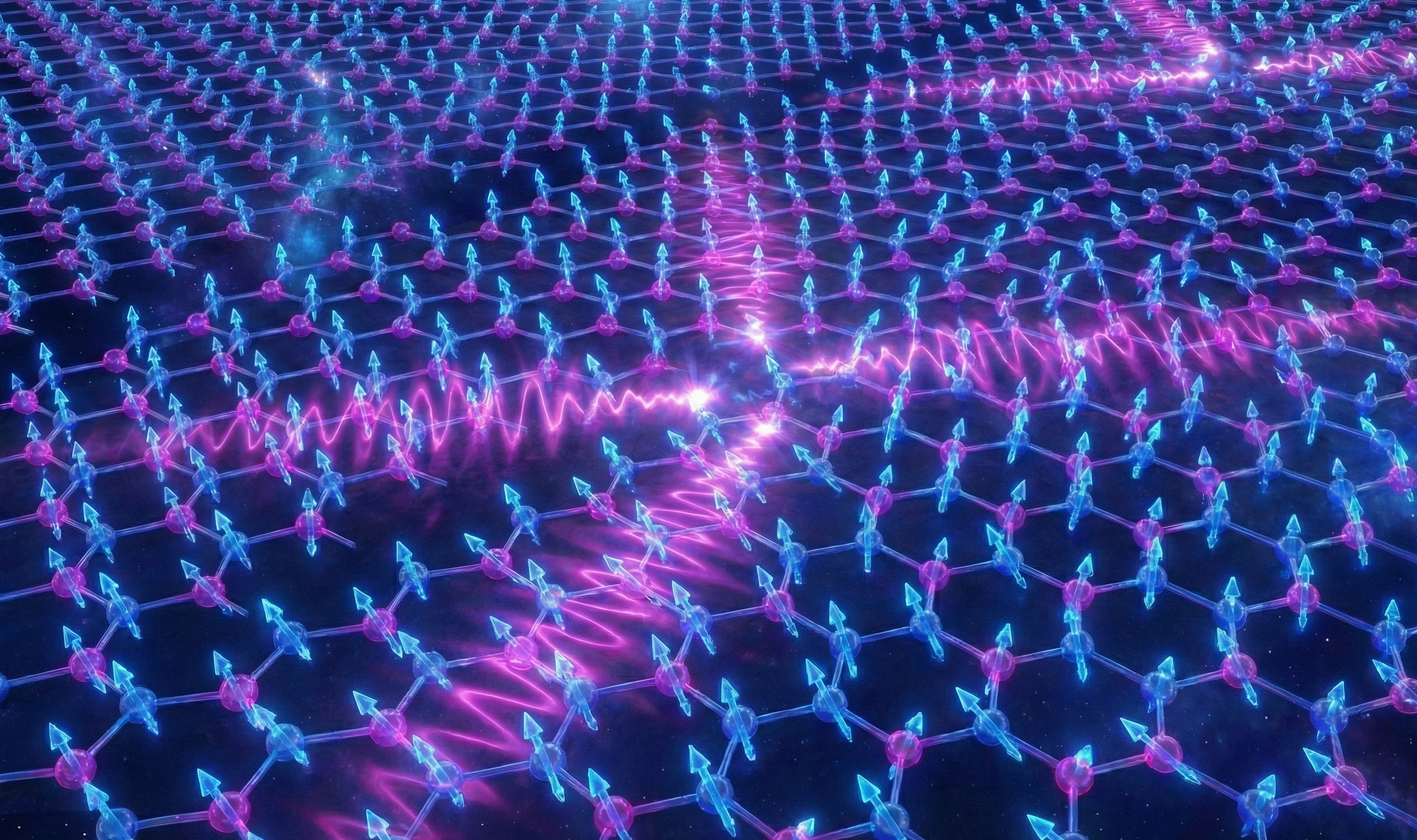
In this line of work, we use inelastic neutron and resonant X-ray scattering on itinerant antiferromagnets and correlated insulators to resolve how magnon branches hybridize with optical phonons. By quantifying dispersion renormalization, linewidth broadening and spectral-weight transfer, we build microscopic models that connect spinlattice coupling to macroscopic transport properties. The broader goal is to understand when magnonphonon coupling can be engineered to either enhance or suppress heat and spin currents in candidate magnonic and thermoelectric devices.

Neutron Scattering Magnons Thermal Transport
Learn More →
High-Entropy Oxides

High-Entropy Oxides

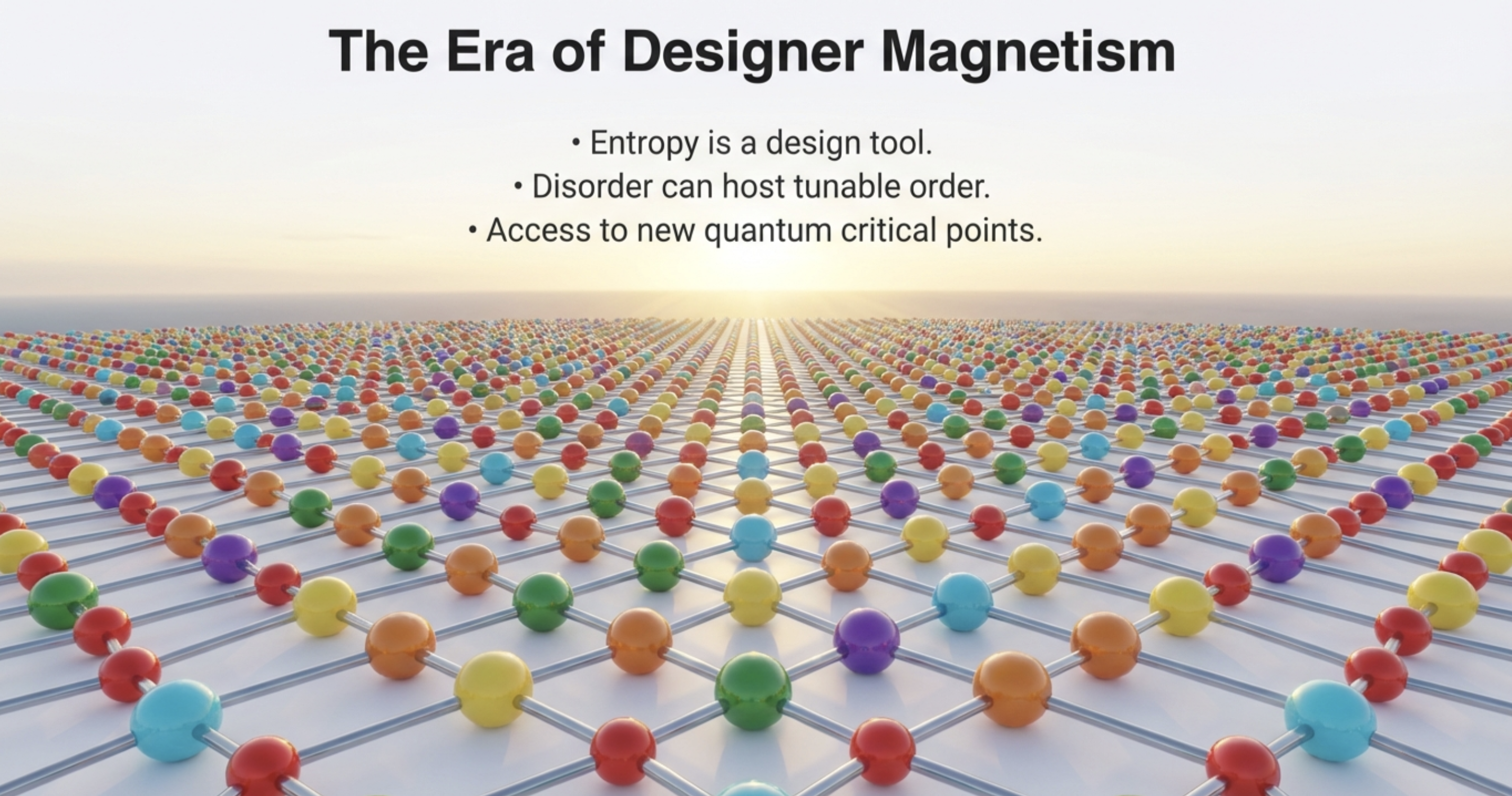
Here we study chemically complex, high-entropy oxides and characterize them mainly using neutron and X-ray diffraction and total scattering to map how multi-cation disorder and strain fields shape their magnetic landscape. By focusing on how scattering signatures evolve with temperature and field, and comparing to reported macroscopic responses, we distinguish conventional glassy freezing from genuinely frustrated collective states. Statistical and mean-field models then link the enormous cation-configuration space to experimentally observed scattering signatures, with an eye toward designing disordered oxides that host robust, tunable magnetic functionalities.

Disorder Magnetism X-ray Scattering
Learn More →
Honeycomb Lattice Magnetism

Honeycomb Lattice Magnetism

We work on artificial permalloy honeycomb lattices that realize tunable, frustrated Ising-like networks. We track how field history, temperature and geometry drive the system between ice-like, charge-ordered and diode-like conducting states, and relate these regimes to changes in their collective magnetic configurations. Simple models then connect local vertex configurations and magnetic-charge textures to non-reciprocal transport signatures and ultra-low forward-voltage behaviour, highlighting routes toward neuromorphic elements and energy-efficient magnetic diodes built from geometrically engineered frustration.

Frustrated Systems Topology Magnetism
Learn More →
Quantum Magnetism

Quantum Magnetism

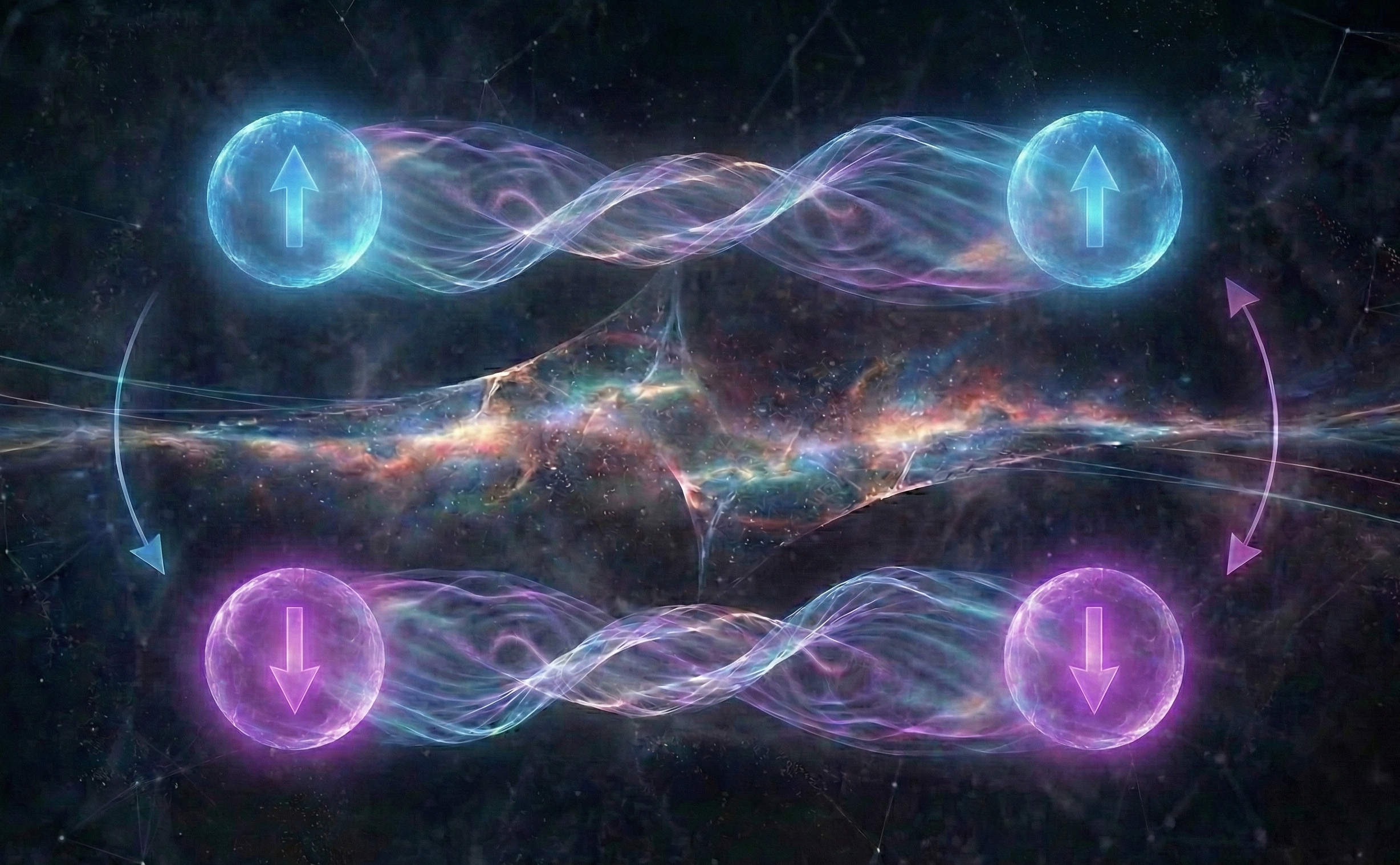
In this initiative, I work on model quantum magnets where reduced dimensionality, frustration and anisotropic exchange produce large quantum fluctuations. Using elastic and inelastic neutron scattering together with numerical modelling, we search for proximate spin-liquid regimes, multipolar orders and excitation continua that go beyond simple magnon pictures. The aim is to identify chemically accessible platforms where entangled ground states and robust collective modes coexist, providing realistic opportunities to couple quantum spin degrees of freedom to spintronic or quantum-information architectures.

Quantum Materials Spintronics DFT
Learn More →

Selected Publications

Constraints on magnetism and correlations in RuO₂ from lattice dynamics and Mössbauer spectroscopy

George Yumnam, Parul R. Raghuvanshi, John D. Budai, Dipanshu Bansal, Lars Bocklage, et al.

Cell Reports Physical Sciences, 2025

View Publication →

Magnon gap tuning in lithium-doped MnTe

George Yumnam, Duncan H. Moseley, Joseph A. M. Paddison, Christiana Z. Suggs, Emma Zappala, et al.

Physical Review B, 109, 214434 (2024)

View Publication →

Field and temperature tuning of magnetic diode in permalloy honeycomb lattice

George Yumnam, Moudip Nandi, Pousali Ghosh, Amjed Abdullah, Mahmoud Almasri, et al.

Materials Today Advances, 18, 100386 (2023)

View Publication →

Magnetic charge and geometry confluence for ultra-low forward voltage diode in artificial honeycomb lattice

George Yumnam, Jiasen Guo, Yiyao Chen, Ashutosh Dahal, Pousali Ghosh, et al.

Materials Today Physics, 22, 100574 (2022)

View Publication →
View Full Publication List

Teaching & Mentoring

I design short courses and reading groups on neutron and X-ray scattering, classical and quantum magnetism, and data-analysis workflows. I emphasize making raw data and analysis scripts readable, reusable, and easy to build on.

As a postdoctoral researcher, I typically join projects once a concrete materials or scattering question is on the table. I am not currently hiring students directly, but I am very happy to co-advise, mentor on neutron and X-ray scattering experiments, and collaborate on joint proposals or data-driven projects.

Collaboration Opportunities

Co-advised Students

Joint projects on neutron and X-ray scattering studies of magnon dynamics and related quantum materials.

Visiting Researchers

Short-term visits to pair scattering experiments with shared analysis notebooks and open data pipelines.

Collaborative Proposals

Partners on neutron/X-ray scattering experiments on magnetic and quantum materials with shared authorship plans.

Let's Work Together

I'm always interested in hearing about new projects and opportunities.

Location

Department of Physics

Scholar Profile

Google Scholar