← Back to Research
Hybrid Magnon Excitations: Crystal Fields & High-Entropy Oxides
Y-doped TbSb · Magnon-CEF hybridization · High-entropy oxides
TbSb is a rock-salt rare-earth antiferromagnet that orders below TN ≈ 15 K. The Tb³⁺ ions carry large magnetic moments and experience a strong cubic crystal field from the surrounding Sb cage, which splits the J = 6 ground multiplet into a well-characterized level scheme. Substituting non-magnetic yttrium for terbium progressively dilutes the magnetic sublattice, and percolation theory predicts that long-range order and coherent spin waves should break down below the percolation threshold.
The spin waves in Y-doped TbSb prove considerably more robust than this picture suggests. Measuring the magnon spectrum across a series of (Tb1−xYx)Sb samples with inelastic neutron scattering, I find well-defined magnon branches persisting at dilutions where simple models predict collapse. The most likely explanation is crystal-field hybridization: mixing between single-ion levels and collective modes appears to stabilize the magnons against dilution. The measurements combine inelastic neutron scattering on HYSPEC, ARCS, and VERITAS with three-dimensional magnetic pair distribution function analysis at CORELLI (SNS, ORNL), elastic diffraction across the doping series, bulk characterization, and crystal-field modeling. The central questions are where coherent magnon branches actually break down relative to the classical percolation threshold, what quantitative role the hybridization plays in protecting magnon coherence, and whether the mechanism generalizes to other rare-earth antiferromagnets with strong single-ion anisotropy.
TbSb is well suited to this problem because its single-ion physics is thoroughly characterized. The Tb³⁺ crystal-field parameters in the cubic Sb environment were established by earlier optical and neutron spectroscopy, the magnon dispersion of the parent compound is cleanly resolved, and Y³⁺ substitutes for Tb³⁺ without distorting the lattice or introducing charge disorder. Any deviation from percolation behavior can therefore be attributed directly to the crystal-field coupling, with no competing structural or electronic explanation.
This is the principal advantage of TbSb over more complex diluted magnets, in which several mechanisms act simultaneously and cannot be separated from scattering data alone. TbSb reduces the general question of whether single-ion anisotropy protects collective magnetism in a disordered system to a clean, controlled experiment.
The crystal field splits the ground multiplet of a rare-earth ion into discrete levels. When the separation between the ground state and the excited levels is comparable to the magnon bandwidth, the two types of excitation hybridize into mixed magnon–crystal-field (magnon-CEF) modes. The effect is purely quantum mechanical, with no classical counterpart, and can substantially modify the magnon dispersion, lifetime, and gap.
Dilution adds a further ingredient. Each Tb³⁺ site experiences a local environment set by its particular Y/Tb neighborhood, so the crystal-field splittings acquire a distribution across the sample. Our measurements address how this distributed coupling feeds back into the collective spectrum, in particular whether the hybridization pins the magnon branches or broadens them, and how the behavior evolves with doping and temperature.
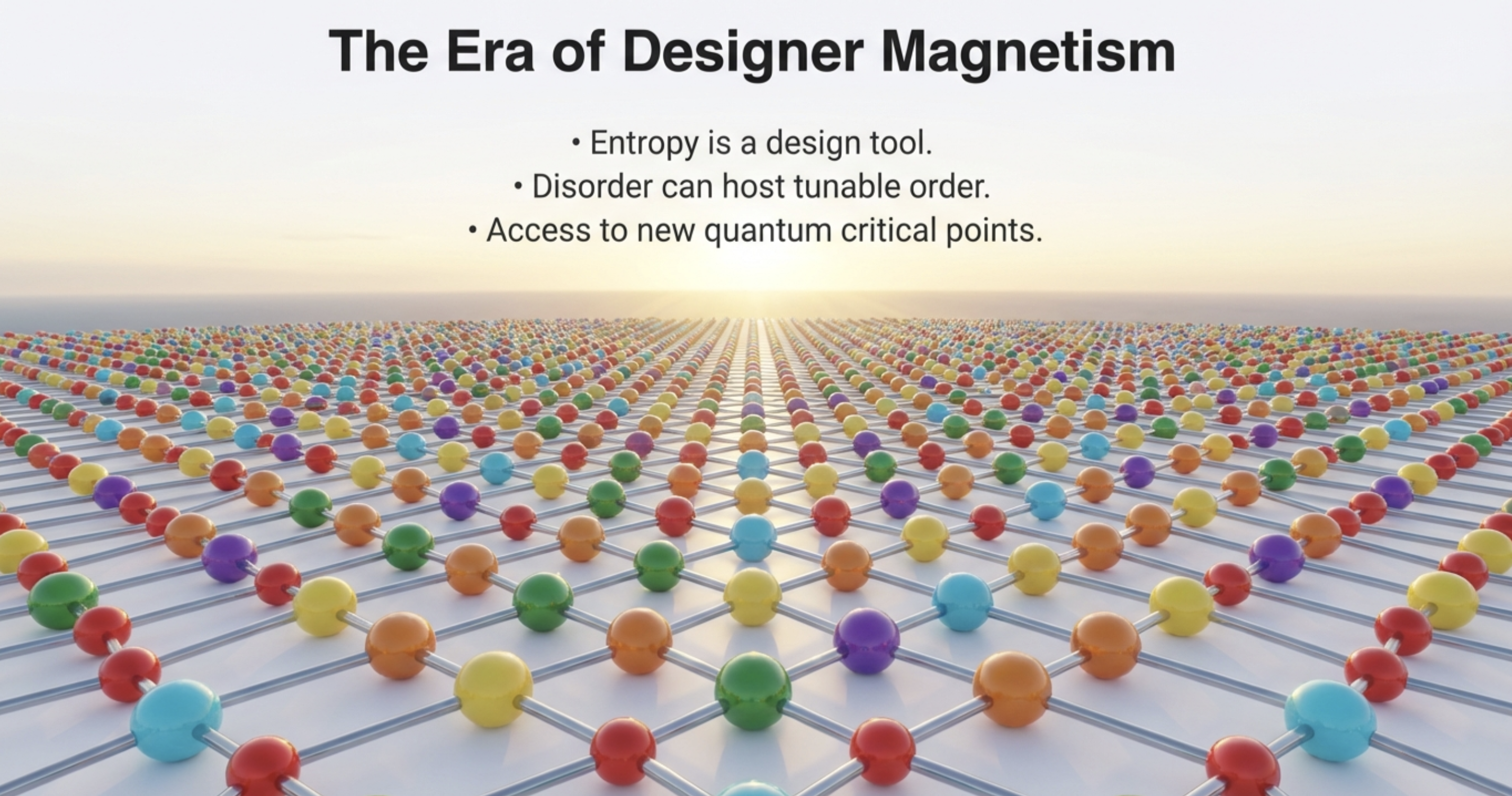
High-entropy oxides take chemical disorder to its extreme: five or more cations share a single sublattice in near-equal proportions, yet the compounds crystallize in simple structures such as rock salt. In these materials, the same physics studied in diluted TbSb, namely the interplay of local site disorder with collective magnetic and lattice excitations, operates at maximal compositional entropy. Working with collaborators at Oak Ridge National Laboratory, I contributed neutron scattering measurements of the magnetic and lattice thermodynamics of bulk rock-salt high-entropy oxides, tracking how the coupled spin and phonon spectra respond to extreme cation disorder.
See:
The TbSb doping series is being extended toward the percolation limit, with crystal-field modeling used to isolate the single-ion contribution to the magnon stabilization. First results were presented at the APS Global Physics Summit 2025.
Establishing when and why collective spin excitations survive magnetic disorder is a central question in quantum magnetism. The magnon coherence length governs thermal conductivity in magnetic insulators, sets the range of spin-wave propagation in magnonic devices, and limits the fidelity of quantum correlations in candidate quantum materials. Determining the conditions under which dilution destroys magnon coherence, and identifying the mechanism when it does not, provides design principles for disorder-tolerant magnetic systems.
For a complete list of publications and presentations, see my Google Scholar profile.